
When the Eye Falls to the Margin
In the sumptuous frontispiece illuminated by Giovanni Pietro Birago for the copy of the Sforziade now in Warsaw, a small, apparently playful scene conceals something far more complex.
But what exactly are we looking at? A celebration of a marriage? A private joke intended for a select few? Or a genuine piece of political caricature?

At first glance, it is difficult even to know where to look. The page fully embraces the visual language of this kind of celebratory work: sumptuous, opulent, almost overwhelming. Gold, blue, and red, coats of arms, heraldic devices, fantastic animals, putti, jewels, and vegetal motifs create a frame of extraordinary richness. Within the large initial appears Francesco Sforza, the Pater Patriae of the dynasty, represented with solemn prominence. Every element seems designed to celebrate the Sforza family.
Then the eye moves down towards the lower margin, and the tone changes.
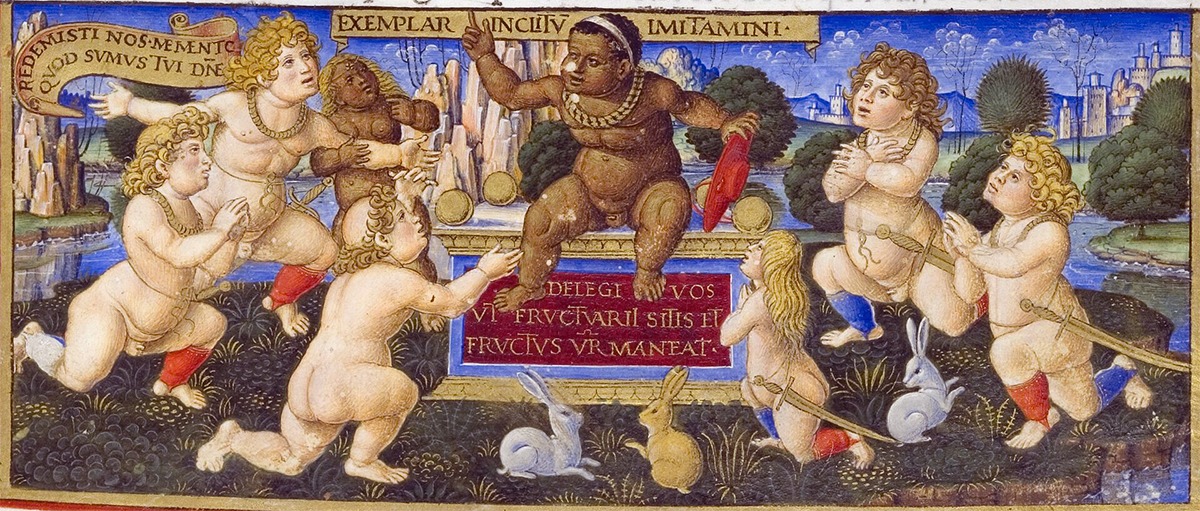
Amid all this magnificence appears a small theatrical scene populated by nude, childlike, vaguely grotesque figures. At the centre sits a dark-skinned figure. Around him are other diminutive men: some kneeling, others armed, one tonsured. In the foreground, two rabbits leap about. A little farther away, a young dark-skinned woman with long blond hair appears beside a young man.
Who, then, is the small black figure seated at the centre?
It is Ludovico Maria Sforza, known as il Moro.
And with that identification, the strange marginal decoration, which until a moment ago seemed almost incidental, takes on an entirely different significance.

The Sforziade: History, Memory, and Legitimacy
To understand how such an image came into being, however, we need to step back and begin with the book itself.
The Sforziade derives from Giovanni Simonetta’s Rerum gestarum Francisci Sphortiae commentarii. Simonetta was a member of the Sforza chancery and one of the most important officials in the ducal administration. He was also the brother of Cicco Simonetta, one of the principal architects of the Milanese administrative machine and a central figure in Sforza government until his downfall and eventual execution amid the new political order created by Ludovico Sforza’s rise to power.
Giovanni Simonetta’s work, however, was not written simply to recount the adventurous life of a great military commander. The story of Francesco Sforza also had an unmistakable political purpose.
The new Milanese dynasty faced a fundamental problem: legitimacy. Francesco had married Bianca Maria Visconti and, following the death of his father-in-law Filippo Maria and the brief interlude of the Ambrosian Republic, had conquered Milan. His authority, however, did not derive from a straightforward dynastic succession, and the question of imperial investiture continued to weigh heavily on the construction of the new ducal authority.
To tell Francesco’s story, therefore, meant doing more than celebrating his achievements. It meant constructing memory, continuity, and, ultimately, legitimacy. The Sforza chancery also possessed an exceptional documentary archive to which Giovanni Simonetta, by virtue of his position, had direct access. Danila Scalmazzi has shown how deeply the Commentarii were rooted in this political and documentary environment.
A few decades later, that same history became useful to Ludovico il Moro.
From 1480 onwards, Ludovico progressively assumed effective control of the Milanese government, while his nephew Gian Galeazzo remained duke in name. In practice, Ludovico was the man making the decisions, a situation contemporary sources describe quite clearly.
It was in this context that Ludovico commissioned a vernacular translation of Simonetta’s work. It is not difficult to see in the project a new need for self-representation: Francesco’s glorious past offered his son a powerful means of presenting the dynasty and, inevitably, himself.
The translation was entrusted to the Florentine humanist Cristoforo Landino, through the mediation of Lorenzo de’ Medici’s circle.¹ Documentation preserved in the State Archives of Florence allows us to follow the project with unusual precision. On 19 June 1484, Lorenzo recorded that Ludovico had already ordered the translation of the “historia sforzesca”. By May of the following year, the work had been completed, and il Moro was awaiting its arrival in Milan with some impatience.
The printed edition appeared in 1490, produced by Antonio Zarotto.² Here too, the surviving documentation is revealing. The publishing project envisaged seven hundred copies on paper and only four luxury copies on parchment. These were hardly books intended to be forgotten on a shelf. They were objects of representation and display, designed to be shown, presented as gifts, and read through images as well as words.


A Court in Miniaturea
It is precisely those four copies that concern us here. Three have survived substantially intact and are now preserved in Warsaw, Paris, and London; fragments of the fourth are held in the Uffizi.
Their frontispieces are associated with the work of Giovanni Pietro Birago and present different iconographic programmes, adapted to their recipients and to specific dynastic circumstances. The Warsaw example is perhaps the most enigmatic.
Birago constructs a kind of parallel narrative alongside the written text. The book celebrates Francesco, but the miniature also speaks about the present.
Along the lower border we encounter the same small, childlike figures introduced above: not quite children, not exactly dwarfs, but something halfway between putti and adults reduced in scale.
At the centre sits il Moro. Scholars have identified the young dark-skinned, blond-haired woman as Bianca Sforza and the young man accompanying her as her husband, Galeazzo Sanseverino, one of the court’s most trusted military commanders and the son of Roberto Sanseverino.
The frontispiece also contains heraldic references to the couple: interlaced rings for Bianca and the fleece of Gideon associated with Galeazzo.
The two rabbits in the foreground do little to preserve the scene’s official tone. Proverbially prolific animals, they offer a less-than-subtle allusion to the fertility of the young couple. When the continuation of the Sforza line was at stake, Birago seems to have decided that subtlety could wait.

Around Ludovico, meanwhile, the diminutive courtiers wear necklaces, carry swords, and display clothing that evokes the world of the Sforza court.
Among the most intriguing figures is a tonsured prelate kneeling before il Moro, his hands extended towards the cardinal’s galero held by Ludovico.
The precise identity of this figure remains uncertain, and caution is necessary. One intriguing possibility is Guidantonio Arcimboldi, Archbishop of Milan. Whatever the identification, the historical context is suggestive: Ludovico did indeed attempt to secure the cardinalate for Arcimboldi, but without success. The archbishop died in 1497 without ever receiving the red hat.³
If the figure is indeed Arcimboldi, the irony becomes particularly sharp: even the highest ecclesiastical ambitions would seem to depend, almost literally, on the duke’s hands.


Il Moro Cut Down to Size
Yet the figure that inevitably draws the eye is Ludovico himself.
Il Moro does not appear as we might expect a prince of his rank to be represented. There is no gleaming armour, no sumptuous brocade, none of the familiar visual instruments through which Renaissance power liked to present itself.
The duke is naked and dark-skinned, transformed into a childlike figure seated at the centre of a court that has undergone exactly the same treatment.

Birago does not distort the duke’s face, turn him into a monster, or resort to exaggerated physiognomic caricature. Instead, he does something much simpler.
He cuts him down to size.
And that alone is enough to disrupt the traditional visual grammar of ducal representation.
One detail is impossible to overlook: Ludovico points upwards, towards the image of his father, Francesco.
Above the scene appears the inscription EXEMPLAR INCLITUM IMITAMINI: “Imitate the illustrious example.”
The illustrious example is clearly Francesco Sforza.
The contrast is unforgiving. On one side stands the founder of the dynasty, the military commander who conquered Milan, the Pater Patriae. On the other sits his son, naked and infantilised, pointing up at him from below.
The father remains the model. His son, visually at least, still seems to have some way to go before matching his stature.

>>>>>The contrast becomes even more striking when compared with the fragment of the Sforziade now in the Uffizi, where Francesco appears surrounded by the great military commanders of the past. In the Warsaw miniature, Ludovico occupies a compositionally comparable position, but his entourage could hardly be more different: no military Olympus, no assembly of heroes. Instead, he is surrounded by a little company of armed and kneeling putti.

Political Caricature or Courtly Joke?
This is an exceptional image within the cycle, marked by a genuine element of caricature and perhaps conceived in an environment hostile to il Moro.
Under such an interpretation, Ludovico becomes the naked usurper, celebrated by a miniature court of flatterers, while Gian Galeazzo—the legitimate duke until his death in 1494—remains the great absentee, evoked through symbols and devices scattered across the page. Read in this way, the scene acquires a much sharper political edge.
Gian Galeazzo’s death certainly provided fertile ground for such an interpretation. During his illness, suspicions concerning il Moro had already begun to circulate, and after the duke’s death on 21 October 1494, allegations of Ludovico’s possible involvement continued to spread. There is no conclusive evidence that Gian Galeazzo was poisoned, but such suspicions already belonged to contemporary accounts and perceptions of the event; they were not merely legends constructed centuries later.
Yet what appears subversive to modern eyes may also have belonged to the private, ironic language of court culture.
Fifteenth-century courts delighted in devices, mottos, nicknames, double meanings, and allusions that could be fully understood only by those familiar with the people and circumstances involved. Not everything that provoked laughter was necessarily intended to undermine authority.
Ludovico himself consciously played with his nickname, “il Moro”, and with the imagery it could generate. Representing him as a little moro could therefore function simultaneously as a personal allusion, a courtly joke, a tribute, and a form of teasing.
Satire Disguised as Decoration
The satire—if satire it is—is not hidden in the literal sense. It is there in plain sight. What conceals it is the context: the gold, the coats of arms, the heraldic devices, the sheer magnificence of the page.
It is, in a sense, disguised as decoration.
Within one of the most sophisticated celebratory objects produced for the Sforza dynasty, we therefore find an image that can be read as a family tribute, a marriage allegory, a private joke, and, at the same time, a possible piece of political caricature.
How much of it was affectionate and how much was corrosive we will probably never know with certainty.
Perhaps we do not need to choose.
It is precisely this ambiguity that continues to draw the eye towards the lower margin of the page, while above it Francesco Sforza retains all his solemn dignity.
Beneath the gold, the heraldry, and the rhetoric of dynasty, Birago may have left us something surprisingly modern: a fifteenth-century satirical cartoon.
And more than five centuries later, the joke still works.
Ludovico il Moro: Satire in the Sforziade? – Eugenio Larosa
Notes:
1. Archivio di Stato di Firenze, Mediceo Avanti il Principato, filza 63, cc. 30v-31r; filza 51, docc. 311-312, 323, 330.
2. Archivio di Stato di Milano, Notarile, Gadio Antonio q. Giovanni, 2784.
3. The identification of the prelate depicted in the miniature as Guidantonio Arcimboldi should be regarded as hypothetical. It is, however, documented that Ludovico il Moro attempted to secure the cardinalate for him, which the archbishop did not obtain before his death in 1497. See N. Raponi, “Arcimboldi, Guidantonio,” in Dizionario Biografico degli Italiani, vol. III, Rome, Istituto dell’Enciclopedia Italiana, 1961.
Bibliography
Primary Sources and Editions
SIMONETTA, Giovanni, Historia delle cose facte dallo invictissimo duca Francesco Sforza [Sforziade], trans. Cristoforo Landino, Milan, Antonio Zarotto, 1490.
SIMONETTA, Giovanni, Rerum gestarum Francisci Sfortiae Mediolanensium ducis commentarii, ed. Giovanni Soranzo, in Rerum Italicarum Scriptores, 2nd ed., XXI/2, Bologna, Zanichelli, 1932–1959.
SCALMAZZI, Danila, Tra Milano e Firenze. Cristoforo Landino volgarizzatore dei Rerum gestarum Francisci Sphortiae commentarii di Giovanni Simonetta. Edizione critica della Sforziade di Cristoforo Landino, Milan, Ledizioni, 2021, ISBN 978-88-5526-440-2. This volume provides the most substantial basis for the textual history of the work, the commissioning of its vernacular translation, and its publication.
Studies on the Sforziade and its Miniatures
COMANDUCCI, R. M., “Nota sulla versione landiniana della Sforziade di Giovanni Simonetta,” Interpres, 12, 1992, pp. 309–316.
COTTE, Pascal – KEMP, Martin, La Bella Principessa and the Warsaw Sforziad, online study, 2011.
EVANS, Mark L., “New Light on the ‘Sforziada’ Frontispieces of Giovan Pietro Birago,” The British Library Journal, 13, no. 2, 1987, pp. 232–247.
HORODYSKI, Bogdan, “Miniaturzysta Sforzów,” Biuletyn Historii Sztuki, XVI, no. 2, 1954, pp. 185–213.
HORODYSKI, Bogdan, “Birago, miniaturiste des Sforza,” Scriptorium, 10, no. 2, 1956, pp. 251–255.
MCGRATH, Elizabeth, “Ludovico il Moro and His Moors,” Journal of the Warburg and Courtauld Institutes, 65, 2002, pp. 67–94.
MULAS, Pier Luigi, “‘Auctore Mauro filio’. Il programma iconografico dei frontispizi miniati dei Commentarii di Giovanni Simonetta,” Bulletin du Bibliophile, 1, 1996, pp. 9–34.
Online Studies and Contributions
GLORI, Carla, “La ‘Sforziade’ e le miniature del Birago: l’epopea sforzesca e il destino tragico di Gian Galeazzo Sforza. Parte I,” Fogli e Parole d’Arte, 11 May 2014.
GLORI, Carla, “La ‘Sforziade’ e le miniature del Birago: l’epopea sforzesca e il destino tragico di Gian Galeazzo Sforza. Parte II,” Fogli e Parole d’Arte, 22 May 2014.
RAPONI, Nicola, “Arcimboldi, Guidantonio,” in Dizionario Biografico degli Italiani, vol. III, Rome, Istituto dell’Enciclopedia Italiana, 1961.
Archival Sources
Archivio di Stato di Firenze, Mediceo Avanti il Principato, filza 63, cc. 30v–31r; filza 51, docc. 311, 312, 323, 330: documents relating to the commissioning, preparation, and delivery of the translation of the Sforziade to Ludovico il Moro.
Archivio di Stato di Milano, Notarile, Gadio Antonio q. Giovanni, 2784: agreements dating from 1490 concerning the printing of the Sforziade, the supply of paper, and the number of copies to be produced on paper and parchment.
Esemplari e segnature
Warsaw, Biblioteka Narodowa, Inc. F. 1347 — copy of the Sforziade containing the frontispiece by Giovanni Pietro Birago discussed in this article.
Parigi, Bibliothèque nationale de France, Rés. Vélins 724.
Londra, British Library, G.7251.
Firenze, Gallerie degli Uffizi, fragments nn. 843, 4423-4430.


